


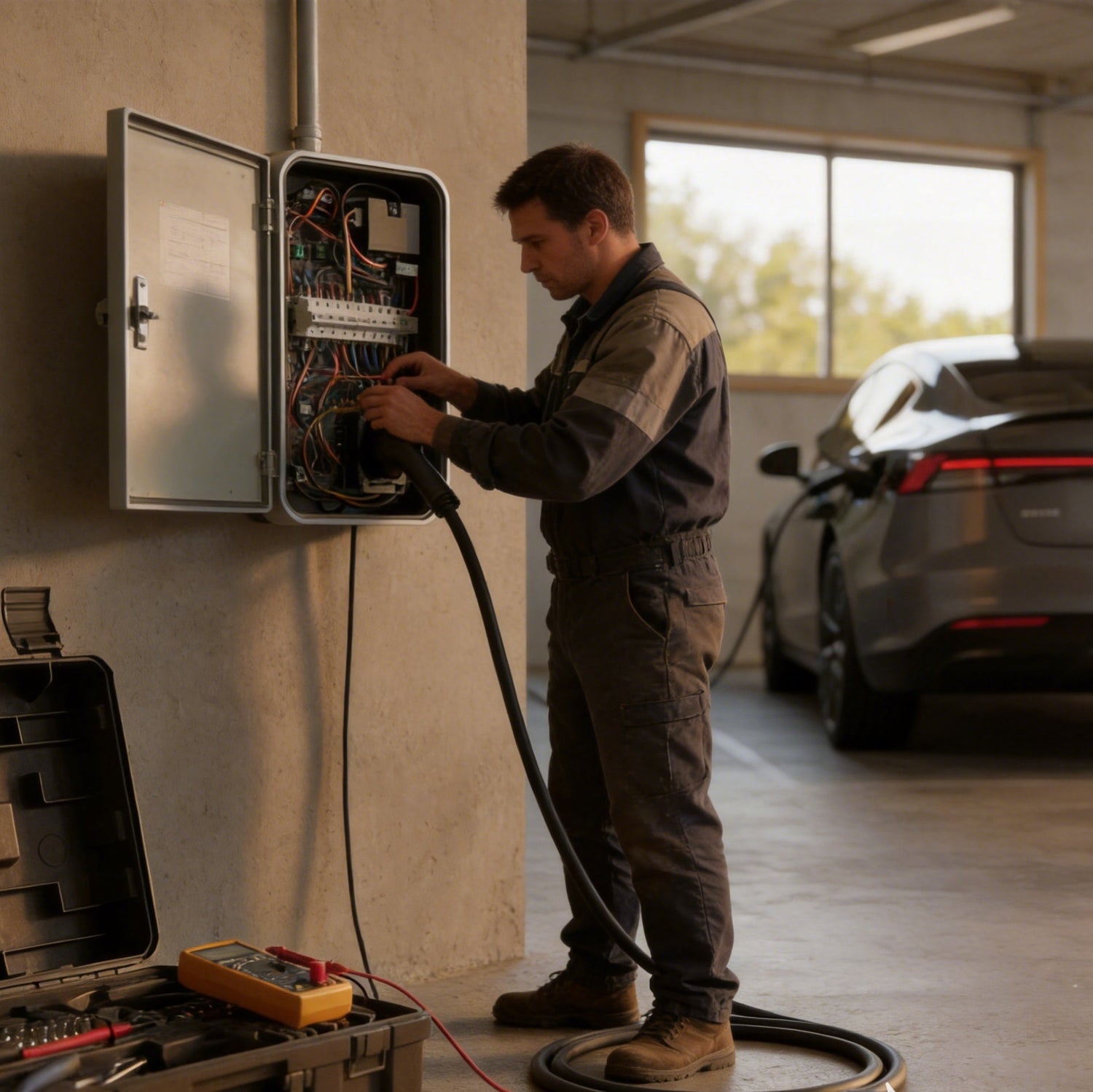
If you’ve just joined the EV world, installing a Level 2 home EV charger is probably your next step. Then a common question quickly arises: should your charger plug into a NEMA 14-50 outlet, or should it be hardwired directly into your electrical panel?
Here’s a detailed, real-world breakdown to help you choose the right setup for your home and lifestyle.
What do NEMA 14-50 and Hardwired Really Mean?
NEMA 14-50
A NEMA 14-50 is a 240-volt electrical outlet, which is often used for electric ranges or RVs. A plug-in Level 2 EV charger connects here. The outlet provides the power, while the charger handles the actual charging.
Key point: the outlet provides electricity, but your charger is what actually controls charging speed, safety, and energy management.
NEMA 14-30
Before NEMA 14-50, some homeowners used older NEMA 14-30 dryer outlets for EV charging. Because it’s limited to a 30-amp circuit, it supports much lower charging speeds for EV charging.
While adapters still exist, NEMA 14-30 setups are generally considered outdated for daily EV charging, because modern EVs and larger battery packs demand faster and more stable charging performance.
Hardwired
The EV charger is permanently connected to your electrical panel with dedicated wiring. There’s no plug, just a direct connection for reliable power delivery.
Hardwired setups are often chosen for long-term installations and outdoor charging stations because they reduce physical connection points and simplify the system.

Differences Between NEMA 14-50 and Hardwired in Installation
Cost Differences: Upfront vs Long-Term Reality
NEMA 14-50 Installations:
If you already have a NEMA 14-50 outlet, plug-in Level 2 EV chargers are generally cheaper to install upfront.
It typically just covers the cost of mounting the charger, and needs to ensure the outlet is rated for continuous EV charging. No major electrical work is required.
Hardwired Installations:
Hardwired installations are usually more expensive upfront because a licensed electrician must run dedicated wiring from the panel to the charger location.
Permits and minor panel upgrades may also be required, which can lead to higher initial costs.
Long-Term Considerations:
- With a plug-in setup, you need to consider the cost of occasional outlet replacement or upgrades if your NEMA 14-50 wasn’t originally installed for continuous EV charging.
- While a hardwired EV charger often reduce wear and tear issues. Over years of daily overnight charging, you may avoid some potential hidden costs.

Reliability in Daily Use: What Happens After Installation
Plug-In Setups:
Pros: A NEMA 14-50 charger is flexible and easy to replace if the charger fails or if you upgrade models.
Cons: Outlets can degrade over time due to heat from continuous charging, loose connections, or improper installation. And if the outlets are not rated for sustained EV charging loads, it could lead to safety risks.
Hardwired Setups:
Pros: A hardwired EV charger has more stable and consistent long-term performance. Fewer physical connections mean less wear and lower risk of overheating, and the wiring is designed for continuous high-load operation.
Cons: It is less flexible if you move or want to upgrade chargers.
Continuous Load Reality:
Level 2 EV chargers typically draw 32–48 amps for several hours overnight. So, ensuring your panel, wiring, and breaker are rated for continuous load is critical for both plug-in and hardwired setups.

Flexibility vs Permanence: What Matters in Real Life
Plug-In Advantages:
- You can easily move the charger if you rent or relocate.
- You can replace or upgrade the charger more easily in the future.
- A NEMA 14-50 outlet can also power RVs or other high-power equipment.
Hardwired Advantages:
- A hardwired setup creates a cleaner and professional look without visible cords or outlets.
- A direct connection removes one potential failure point from the charging system to achieve long-term performance.
- Preferred for outdoor garages or permanent installations where aesthetics and stability matter.

Charging Speed Considerations
Plug-In:
Most NEMA 14-50 outlets support a maximum of 40 amps, which is sufficient for typical daily driving.
For commuters with standard EVs, the difference in charging time may only be 30–60 minutes, often negligible compared to convenience and flexibility.
Hardwired:
It can deliver up to 48 amps in many installations. This higher current may reduce charge times for EVs with large battery packs.
It's ideal for households with multiple EVs, long commutes, or high daily mileage.

Can You Switch Between Plug-In and Hardwired Later?
One reason many homeowners hesitate during EV charger installation is the fear of “choosing wrong”.
The good news is that in most cases, you can switch between a plug-in EV charger and a hardwired EV charger later if your needs change.
However, the process is not always as simple as unplugging one charger and reconnecting another. The difficulty depends on your electrical setup, panel capacity, and the charger itself.
Converting a Plug-In EV Charger to Hardwired:
A hardwired conversion usually involves:
- Removing the NEMA 14-50 outlet
- Connecting the EV charger directly to dedicated wiring
- Installing the correct breaker size
- Verifying the electrical load can safely support higher amperage
It also requires running new wiring and a licensed electrician, which often involves additional cost.
Converting Hardwired to Plug-In:
This is less common, but still possible. Some homeowners later decide they want the flexibility to move the charger or replace it more easily.
In that case, an electrician may:
- Install a NEMA 14-50 outlet
- Add GFCI protection if required by local code
- Adjust breaker sizing if needed
- Verify the outlet is rated for continuous EV charging loads
This option works for those who take flexibility more important than stable and permanent installation.
What Homeowners Often Overlook Before Switching
Changing installation types may also involve:
- Local permits and inspections
- Utility approval requirements
- Additional labor costs
- Charger compatibility limitations
Moreover, not every Level 2 EV charger supports both plug-in and hardwired installation. Some are designed specifically for one setup only.
That’s why EV owners need to think beyond current situation and consider how your charging habits may evolve over the next few years.

Choosing the Right Setup Based on Actual Use Case
Daily vs Occasional Charging
For lighter or occasional charging, a plug-in Level 2 EV charger is often more than enough. It provides solid overnight charging while keeping the setup flexible and easier to change later.
If you charge your EV almost every night, a hardwired EV charger may feel more stable over time. With fewer connection points, many homeowners prefer it for long-term daily charging routines.
Indoor vs Outdoor Installation
For indoor garages, both plug-in and hardwired EV chargers work well when installed correctly.
While outdoor EV charger installation is slightly different. Because hardwired systems eliminate the outlet connection, many homeowners prefer them for weather-resistant setups and fewer exposed components over time.
Short-Term Flexibility vs Long-Term Stability
If you may move within a few years, a plug-in EV charger offers more flexibility. You can unplug the charger, relocate it or replace it more easily later.
For long-term homes where EV charging happens daily, hardwired installation often offers peace of mind and consistent performance.

Common Assumptions That Can Confuse Homeowners
"Hardwired EV Chargers Are Always Safer”
Not necessarily. A poorly installed hardwired EV charger can still create overheating or electrical issues..
The real safety factor is usually:
- Installation quality
- Correct breaker sizing
- Proper wire gauge
- Charger thermal management
Not simply whether the charger plugs in or hardwires.
“Plug-In EV Chargers Are Temporary Solutions”
This idea is extremely common and often inaccurate. Many families use plug-in Level 2 chargers daily for years without issues.
For some EV drivers, 40-amp charging through a high-quality NEMA 14-50 outlet is more than enough for overnight charging.
“The EV Charger Matters More Than Installation”
This is probably the biggest misconception of all.
Even a premium Level 2 EV charger can develop problems if:
- The outlet is low quality
- Wiring connections are loose
- Breakers are undersized
- The electrical panel is overloaded
In real-world home EV charging, installation quality often matters just as much as the charger itself.
That’s why experienced electricians consistently focus on the entire charging system, not just the hardware mounted on the wall.

Final Takeaway: It’s Not About Plug vs Hardwired
Installation Quality Matters Most
No matter which setup you choose, proper EV charger installation has the biggest impact on long-term safety and reliability.
Factors like correct breaker sizing, high-quality wiring, secure connections, and proper thermal management matter far more than simply choosing plug-in or hardwired alone.
Focus on Daily Charging Peace of Mind
Over time, what matters most is having a setup that feels stable, predictable, and easy to live with.
Consistent overnight charging performance and long-term reliability usually make a bigger difference than the connection method itself.

Why Choose RippleOn for Your EV Charger Installation
Whether you choose a plug-in or hardwired setup, RippleOn Level 2 EV chargers are designed to make home EV charging feel simple, reliable, and easy to live with every day.
Our chargers support both NEMA 14-50 and hardwired installation. We hope every homeowner can choose the setup that best fits their home, charging habits, and long-term plans.
More importantly, we focus on what actually matters in real-world EV charging: making sure home EV charging works smartly, quietly and reliably, especially overnight.


Leave a comment
This site is protected by hCaptcha and the hCaptcha Privacy Policy and Terms of Service apply.